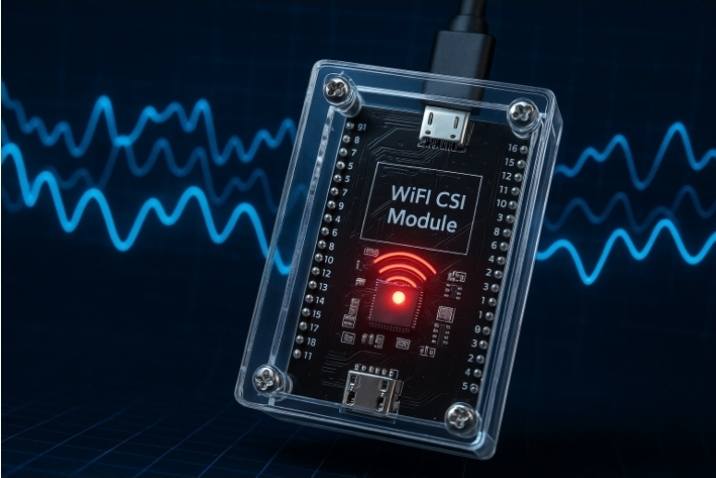
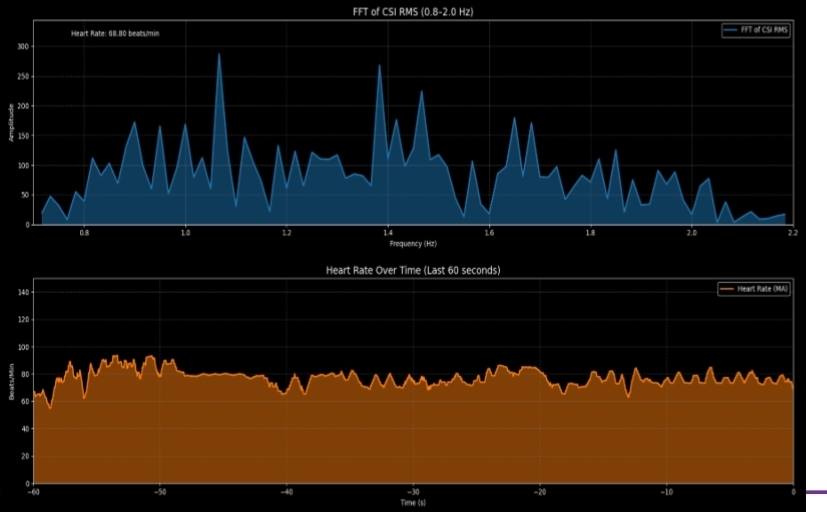
By utilizing ESP32 to capture disturbances in microwave signal propagation (CSI data) and applying algorithms such as FFT (Fast Fourier Transform) to extract subtle human movements.The technology offers the following advantages:
- Enhanced Privacy Protection: Unlike cameras, microwave detection does not involve image recording; it only processes signal spectra. This allows deployment in highly private areas like bathrooms or bedrooms for fall detection or physiological monitoring without infringing on personal privacy.
- Contactless Monitoring: Subjects do not need to wear any devices or electrodes to achieve 24/7 heart rate and respiration monitoring. This eliminates the discomfort and maintenance challenges (e.g., charging, skin irritation) associated with wearables for the elderly or patients.
- Superior Penetration and All-weather Operation: WiFi signals can penetrate walls and obstacles and are unaffected by lighting conditions. Whether in pitch-black darkness or an adjacent room, the system stably detects postures and vital signs, overcoming the limitations of traditional infrared or vision-based sensors.
- Low Cost and Scalability: Based on the widely available ESP32 module, the cost is a fraction of traditional medical-grade radar or multi-camera systems. This enables large-scale deployment in smart buildings, nursing centers, or general households.
Future Development Prospects
Future development will trend toward integration with AI Edge Computing. By leveraging Machine Learning (ML) models, systems will not only detect “presence” but also precisely identify “specific postures” (e.g., stillness, fainting, or abnormal heart rates). This holds immense market value for preventing isolated deaths among the elderly, monitoring sleep apnea, and non-intrusive security systems.
 法藍克機電 Frank Mechatronics
Leave a comment