In KNX or DALI lighting control systems, the parameters you encounter aren’t just numbers,they are carefully designed to make technology align more closely with human physiological perception. Let’s dive deep into the logic behind these two specific settings.
Why use a Logarithmic Dimming Curve?
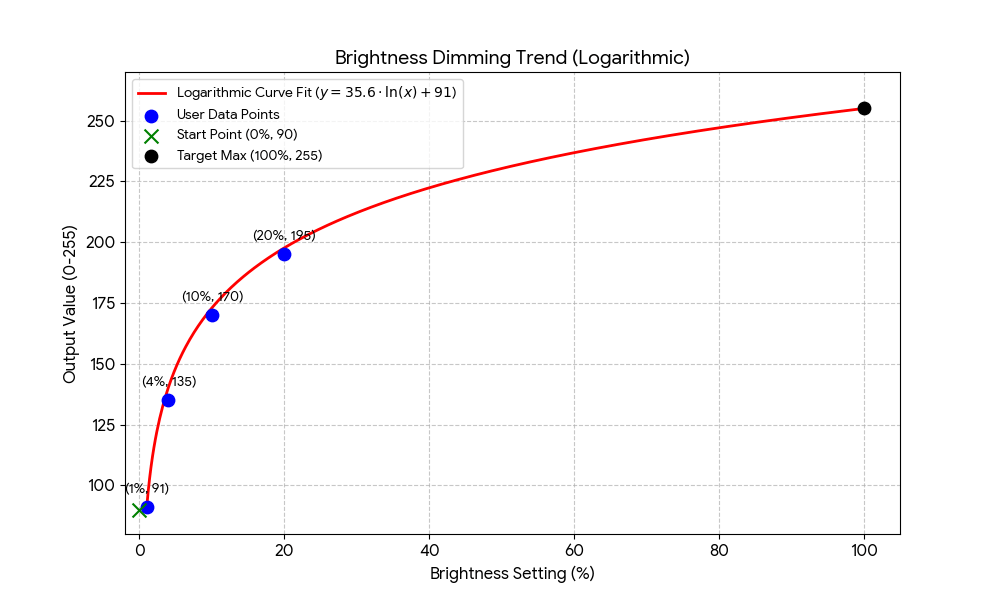
You noticed that at 0%, the output starts at 90 (roughly 35% of the total range). This is a core characteristic of a logarithmic curve.
- The Nature of Human Vision: Human perception of light intensity is non-linear. When a room is dark, our eyes are extremely sensitive to even the slightest increase in light. However, when it is already bright, doubling the physical light output results in a much smaller perceived change.
- Solving the “Responsiveness” Issue: If a Linear output were used, the light would seem to jump too quickly in the low-range (1% to 10%). Users might feel the lamp hasn’t even turned on below 5%, because the physical output is too weak for the eye to register a meaningful change.
- Visual Uniformity: A logarithmic curve concentrates more physical output in the lower percentage settings. By jumping significantly from 0% to 10% (e.g., from 90 to 170), the system compensates for high retinal sensitivity in the dark. This ensures that when you turn a knob or slide a touch panel, the increase in brightness feels smooth and linear to your eyes.
- Why is there output at 0%?This ensures the fixture reaches a stable luminous state the moment it is switched on. Many LED drivers suffer from flickering or color shifting when running at extremely low currents. Setting a “Base Value” ensures a stable, flicker-free dim glow rather than a hesitant or flickering start.
The Purpose of a 2-Second Dimming Period
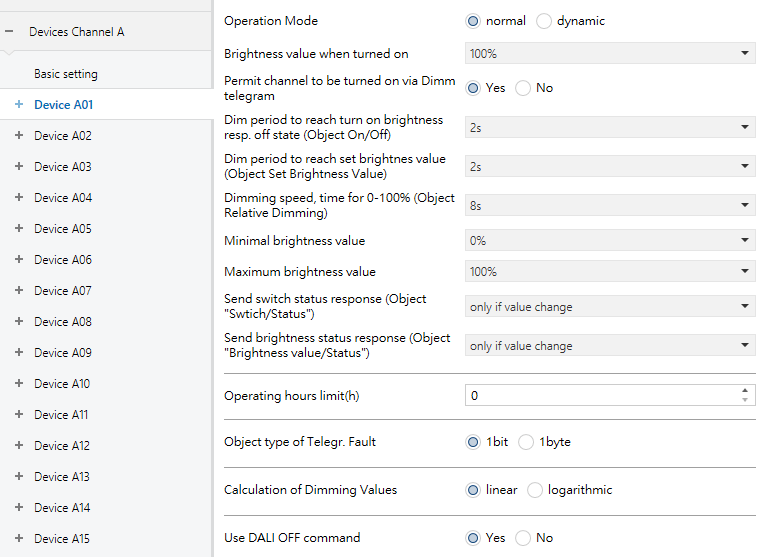
This parameter defines the transition time from “Off” to the “Target Brightness.”
- Psychological and Physiological Comfort:
- Eye Adaptation: Imagine turning on a high-intensity light in a pitch-black room; your pupils would contract sharply, causing discomfort. A 2-second fade provides a “buffer” for the retina to adapt comfortably.
- Aesthetics and Ambience: In luxury hotels, theaters, or high-end residences, “soft-starting” the lights creates a sense of elegance and ceremony, avoiding the jarring nature of mechanical “hard switching.”
- Protection of Electronic Components:
- Reducing Inrush Current: While primarily handled by the driver hardware, a logical “Soft Start” helps mitigate the initial electrical surge, ultimately extending the lifespan of both the lamps and the circuit.
 法藍克機電 Frank Mechatronics
Leave a comment