As the global standard for industrial automation, the integration of PLCopen with AI is not just possible—it is the definitive path for the transition from Industry 4.0 to Industry 5.0, which emphasizes human-robot collaboration and autonomous decision-making.
1. From “Logic Execution” to “Autonomous Reasoning”
Traditional PLCopen standards (such as IEC 61131-3) are based on deterministic “If-Then” logic. In the future, AI will be integrated into the PLC environment as modular “Function Blocks”:
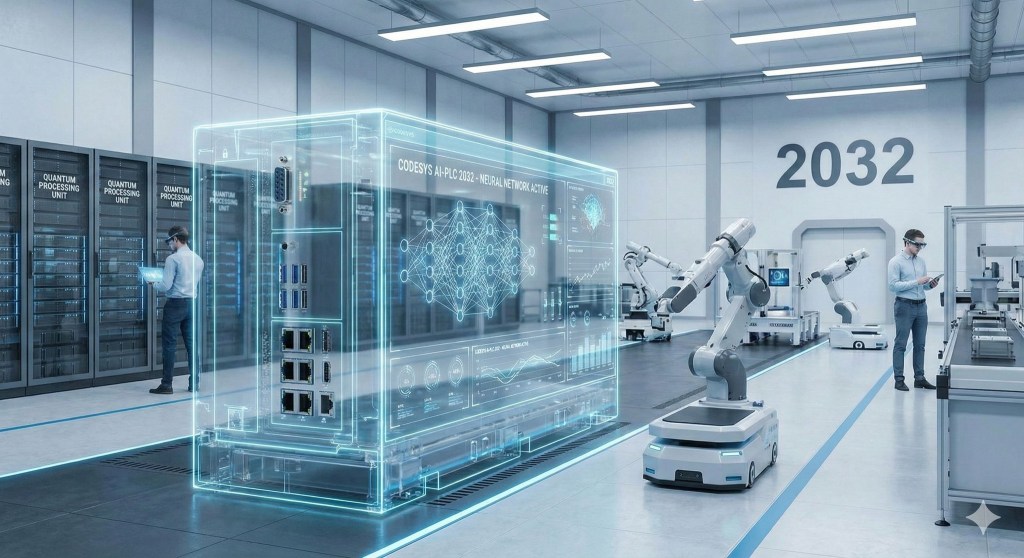
- Neural Network Function Blocks: PLCs will no longer just execute ladder logic; they will call pre-trained AI models. For instance, the “Neural Network Active” display in the image suggests the PLC is processing real-time data from vision sensors for defect detection or path planning in situ.
- Breakthroughs in Edge Computing: As Edge AI chips (such as NPUs for neural processing) are integrated into industrial controllers, PLCs will gain the power to perform AI inference within millisecond cycle times.
2. The Standardizing Role of PLCopen
The core mission of the PLCopen organization is standardization. For AI to enter the industrial sector, the “black box” uncertainty of AI must be addressed:
- Standardized AI Libraries: PLCopen is driving the creation of standard interfaces for AI models. This allows developers to drag and drop a “Predictive Maintenance” or “Adaptive Control” block as easily as they would a motor control block.
- Digital Twin Synchronization: The AR glasses and holographic projections in the image show real-time data overlays. Communication standards like OPC UA ensure that AI decisions and hardware execution remain synchronized with near-zero latency.
3. Implementation Path for the 2032 Vision
The “CODESYS AI-PLC 2032” label in the image highlights key trends for the next decade:
- Self-healing Systems: When a mobile collaborative robot (as seen in the image) encounters an undefined obstacle, the AI-PLC can generate a bypass path in real-time without requiring a manual code rewrite.
- Low-Code/No-Code Development: Future engineers may only need to define a goal (e.g., “Increase throughput by 5%”), and the AI-PLC will autonomously optimize control parameters to reach it.
The fusion of PLCopen and AI is an industrial inevitability. The primary challenge is not whether AI can be embedded into a PLC, but how to establish “Explainable and Safe” industrial AI regulations to ensure that while factories become smarter, they remain firmly under human oversight.
Frank Ho
 法藍克機電 Frank Mechatronics
Leave a comment